Pouyan Alizadeh


Help Empath: Turning Cognitive Training Into a Living Game World
Help Empath is a therapeutic game concept that transforms Cognitive Bias Modification into an explorable city-based experience where adolescents practice adaptive attention, interpretation, and regulation through play.
Role: Game Concept Designer, UX Researcher, Narrative Systems Designer
Timeline: 2025-2026
Output: Pitch Bible, Design Document, Gameplay Systems, Visual Direction
Players guide Empath through a responsive mind-world where everyday moments become playable challenges. As they navigate the city, an Overwhelm system reflects short-term pressure while Clarity tracks growth, progress, and unlocks.The central innovation is the shift from isolated cognitive-training tasks to a living therapeutic game world: practice becomes spatial, emotional, and repeatable.

The Problem: Making Cognitive Practice Feel Playable
Cognitive Bias Modification is built on a simple but powerful idea: with repeated practice, people can learn to notice, interpret, and respond to situations in more adaptive ways. But many traditional CBM tasks feel repetitive, abstract, and disconnected from the real-life moments where attention and interpretation patterns actually matter.
Help Empath reframes that challenge as a design opportunity. Instead of asking players to complete isolated training exercises, the project explores how CBM-inspired practice can become an explorable game world - one where players guide Empath through everyday situations, manage Overwhelm, and build Clarity through meaningful choices.
The core design challenge was to:

-
Turn repetition into meaningful interaction by embedding practice inside a living city-world rather than isolated task screens.
-
Make invisible mental patterns visible through thought clouds, emotional world states, Overwhelm feedback, and Clarity progression.
-
Connect practice to lived experience by translating attention, interpretation, and body-signal challenges into social, physical, and environmental gameplay moments.
What I Designed
I designed Help Empath as a therapeutic game concept that translates Cognitive Bias Modification paradigms into a playable, emotionally responsive city-world. The work included the core game concept, the avatar system, the world metaphor, feedback mechanics, mini-game structure, progression logic, and supporting documentation through a pitch bible and design document.
1. A Living City as the Core Metaphor
The game takes place in a dynamic city that represents the player’s mind. Streets, clinics, social spaces, galleries, and challenge zones become places where cognitive and emotional patterns are externalized through gameplay.
2. Empath as the Player’s Guide
I designed Empath as a gender-neutral, non-human avatar that players can project onto and grow with. Empath’s role is to make the experience feel approachable, emotionally safe, and centered on progress rather than performance.
3. Overwhelm and Clarity as Feedback Systems
I created the Overwhelm Meter to represent short-term pressure and the Clarity progression system to represent long-term growth. Together, they make invisible internal states visible and connect player choices to emotional feedback, world changes, and unlocks.
4. Mini-Games as Therapeutic Practice
I developed multiple mini-games inspired by Cognitive Bias Modification paradigms, including attention, interpretation, memory, body-signal interpretation, and regulation-focused challenges. Each mini-game turns a structured cognitive task into a meaningful scenario, such as crossing a busy street, interpreting messages, cycling uphill, or navigating a social party.
Together, these design pillars turn Help Empath from a set of therapeutic exercises into a cohesive game system where practice becomes spatial, emotional, and repeatable.
Design Challenge
How might we transform repetitive Cognitive Bias Modification tasks into a meaningful game experience that supports repeated practice, emotional safety, and player agency?

1. Make the task meaningful
CBM tasks often rely on repetition, but repetition alone does not create engagement. The challenge was to embed practice inside recognizable moments - crossing a busy street, reading a message, cycling uphill, entering a party - so each task felt connected to everyday emotional experience.
2. Make progress visible
Attention, interpretation, and regulation are usually invisible processes. Help Empath needed feedback systems that could make internal change feel concrete, using tools like Overwhelm, Clarity, thought clouds, world-state shifts, and unlocks.
3. Make failure safe but useful
Because Help Empath is designed around practice, mistakes should not feel punitive. A wrong choice should become a moment to pause, notice what happened, regulate Overwhelm, and try again with more awareness.
Core Gameplay Loop
1. Encounter
Empath enters an everyday challenge, such as a message, street crossing, body signal, or social moment.
This grounds practice in situations that feel recognizable instead of abstract.
2. Notice
The player identifies thoughts, cues, sensations, or environmental signals. This turns automatic reactions into something visible and actionable.
3. Choose
The player selects where to focus, how to interpret the moment, or when to engage. This makes cognitive practice active, intentional, and game-like.
4. Regulate
The player uses adaptive responses to steady Overwhelm and stay engaged. This makes mistakes recoverable and keeps the experience emotionally safe.
5. Grow
Successful practice builds Clarity through repeated choices and feedback. This gives the player a sense of progress beyond a single task.
6. Unlock
Higher Clarity opens new areas, mini-games, and more complex challenges. This makes repeated practice feel purposeful and connected to a larger journey.

Game World
Help Empath takes place inside a living city that functions as both the game’s primary ecosystem and a metaphor for the player’s mind. Each district represents a different kind of cognitive or emotional challenge: busy roads train attention under pressure, social areas focus on interpretation, the clinic introduces grounding tools, and specialized spaces like the gallery, submarine, airplane, and party levels deepen specific skills.

The city responds to the player’s internal state. When Overwhelm rises, the world becomes denser, blurrier, darker, and more difficult to navigate. When Clarity grows, the environment becomes brighter, calmer, and more open. These visual shifts turn emotional state into something the player can see, understand, and influence.

Empath: A Player Avatar for Projection and Growth
Exploration is not separate from practice. Moving through the city means encountering situations, making choices, noticing patterns, and returning to challenges with more confidence. The world becomes a place where therapeutic practice feels spatial, repeatable, and emotionally meaningful.
Empath is designed as a gender-neutral, non-human avatar so players can connect with the character without being asked to see themselves in a fixed identity. Its simple form, soft expression, and approachable design create emotional distance where needed, while still making the experience feel personal and protective.

Because Empath is not overly specific, players can project their own feelings, choices, and progress onto the character. Empath becomes a guide, companion, and reflection point: someone the player can help through difficult moments while also practicing those skills for themselves.
Empath’s visual evolution mirrors the growth of Clarity. As the player practices adaptive attention, interpretation, and regulation, Empath can become more defined, grounded, and confident. This turns abstract progress into something visible and emotionally rewarding.

The character matters because Empath gives the system a heart. Mechanically, Empath anchors the player inside the world and connects choices to feedback. Emotionally, Empath makes practice feel less like completing a task and more like supporting a companion through a meaningful journey.
Intersection of Thoughts
Mini-Games as Therapeutic Practice
Each mini-game in Help Empath translates a Cognitive Bias Modification-inspired paradigm into an emotionally meaningful scenario. Instead of asking players to complete abstract exercises, the game places those skills inside everyday-feeling moments: crossing a street, reading a message, feeling physical effort, choosing what to focus on, or navigating a busy social space.

Intersection of Thoughts
Concept: Empath crosses a busy intersection while avoiding cars, collecting green adaptive thoughts, and avoiding red stressful thoughts.
Target skill: Attention bias and adaptive focus.
Why it works: The street crossing makes attention feel immediate, embodied, and consequential without becoming clinically abstract.

Uphill Climb
Concept: Empath joins a bike race where the real challenge is maintaining rhythm, interpreting effort, and resisting unhelpful comparison.
Target skill: Effort reappraisal, body awareness, and resilience.
Why it works: The race turns physical discomfort and social comparison into a playable challenge about pacing, not ranking.

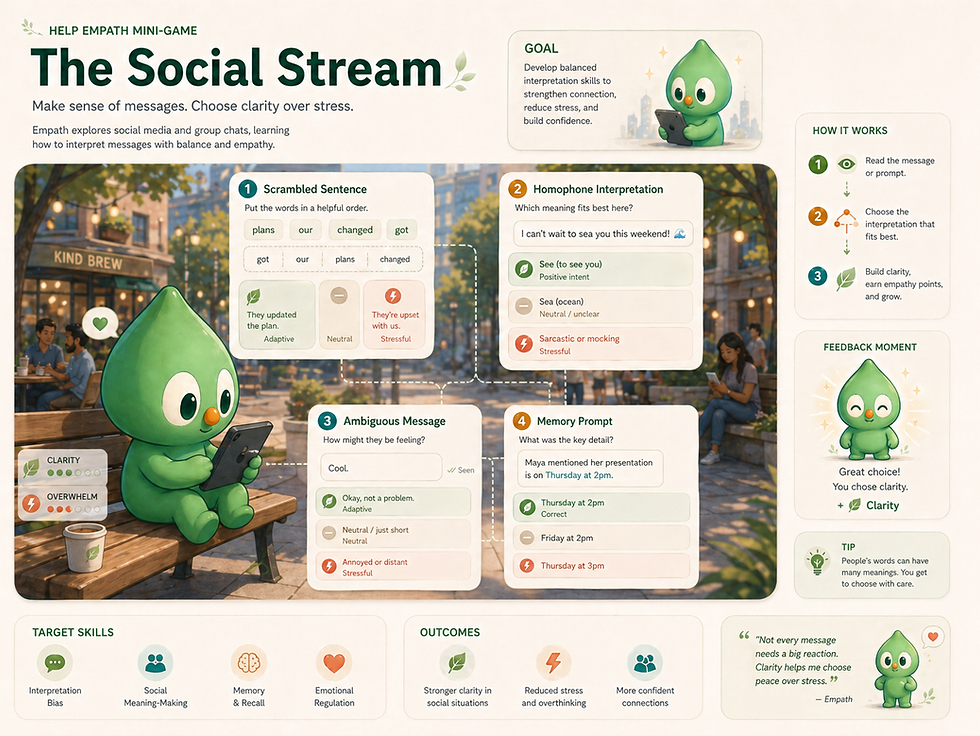
Social Stream
Concept: Empath responds to ambiguous messages through scrambled sentences, homophones, interpretation choices, and memory prompts.
Target skill: Interpretation bias, social meaning-making, and memory recall.
Why it works: Digital messages create familiar, emotionally relevant ambiguity that players can practice resolving with care.
Art Gallery
Concept: Empath curates a gallery by choosing uplifting, grounding artworks over chaotic or overstimulating ones.
Target skill: Selective attention.
Why it works: The gallery makes attention visible as a curatorial choice: what the player focuses on shapes the emotional atmosphere.

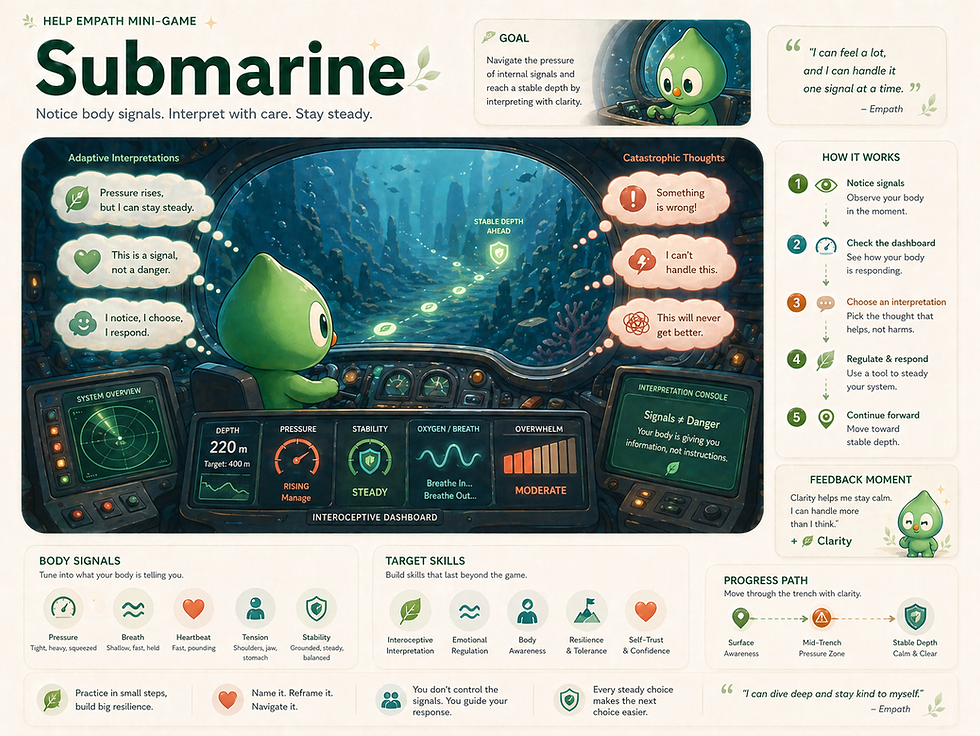
Submarine
Concept: Empath pilots a submarine through a deep trench while interpreting pressure, alarms, and body-like signals without catastrophizing.
Target skill: Interoceptive interpretation and emotional regulation.
Why it works: The submarine turns internal sensations into readable system signals, helping players practice responding instead of spiraling.
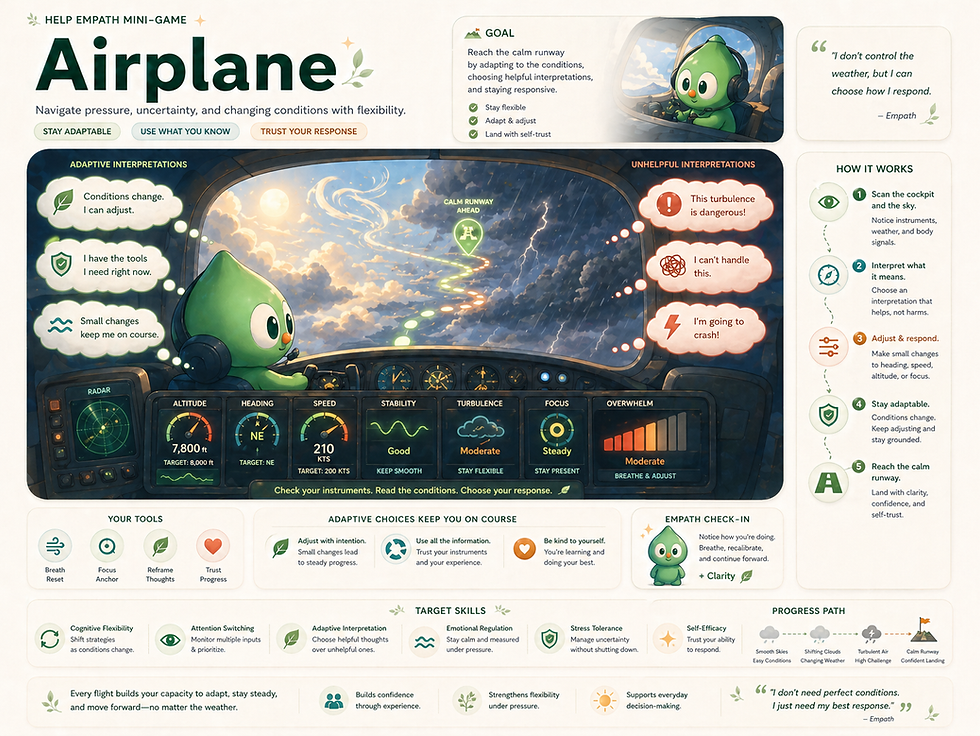
Airplane
Concept: Empath flies through changing weather, monitoring multiple controls while adapting to turbulence and uncertainty.
Target skill: Cognitive flexibility, attention switching, and regulation under pressure.
Why it works: The cockpit creates a clear metaphor for staying responsive when conditions change.
Party Level
Concept: Empath navigates a lively social party by noticing signals, interpreting cues, focusing on safe interactions, and regulating overwhelm.
Target skill: Integrated coping, social interpretation, selective attention, and self-regulation.
Why it works: The final level combines multiple learned skills in one socially rich environment, turning mastery into applied practice.

Design Process
Identifying the Engagement Gap
What I investigated: I looked at why therapeutic tools can lose engagement, especially when they rely on repetition without emotional context, narrative, or visible progress.
What I learned: The core problem was not only clinical or technical. It was experiential: players needed practice to feel meaningful, safe, and connected to everyday life.
How it changed the design: I reframed Help Empath around recognizable moments - messages, traffic, physical effort, social pressure, and overwhelming environments - instead of isolated training screens.
Researching the Problem
What I investigated: I explored Cognitive Bias Modification, chronic pain-related cognitive patterns, and the limitations of repetitive digital therapeutic tasks.
What I learned: CBM paradigms can be conceptually strong, but the experience often feels abstract, task-like, and disconnected from the emotional situations where those skills matter.
How it changed the design: The project needed to become more than a set of exercises. It needed a world, a character, and a reason for players to keep practicing.
Translating CBM Into Game Mechanics
What I investigated: I mapped CBM-inspired paradigms such as attention bias, interpretation bias, memory bias, and body-signal interpretation onto possible game interactions.
What I learned: Each cognitive skill could become a playable choice: where to look, how to interpret, when to pause, what to avoid, and how to respond.
How it changed the design: This led to mini-games like Intersection of Thoughts, Social Stream, Uphill Climb, Art Gallery, Submarine, Airplane, and Party Level, each designed around a specific skill.
Building the Help Empath World
What I investigated: I explored how the game could connect separate mechanics into one coherent experience through worldbuilding, progression, and emotional feedback.
What I learned: The city could act as both the game world and a metaphor for the player’s mind, while Overwhelm and Clarity could make internal states visible.
How it changed the design: The project became a living city system: Empath moves through districts, encounters challenges, manages Overwhelm, builds Clarity, and unlocks more complex experiences over time.

Iterating Toward a Stronger Concept
What I investigated: I refined the game structure, visual language, character role, mini-game logic, and portfolio presentation to make the project feel more cohesive and credible.
What I learned: The strongest version of Help Empath was not a research explanation with game elements added on top. It was a therapeutic game concept where research, mechanics, narrative, and visuals all supported the same experience.
How it changed the design: The final concept became clearer, more portfolio-ready, and easier to communicate through a pitch bible, design document, visual system, world map, character design, progression structure, and mini-game mockups.


Outcome
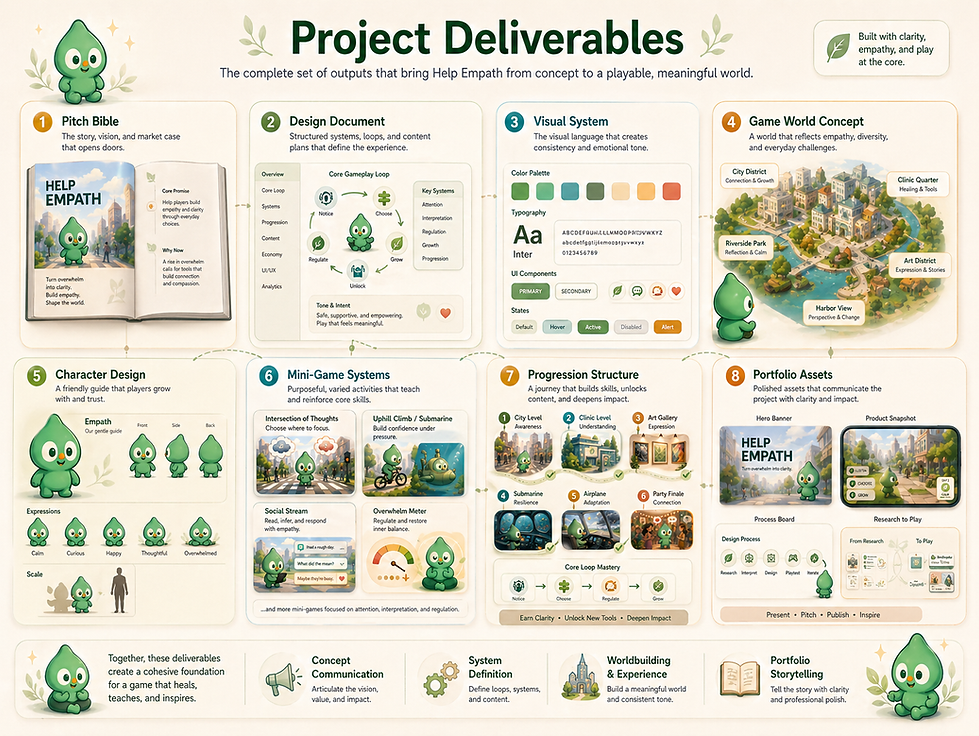
The final outcome of Help Empath is a cohesive therapeutic game concept supported by a complete design foundation. Rather than claiming clinical effectiveness, the project demonstrates how Cognitive Bias Modification-inspired practice can be translated into a playable world, character system, feedback loop, and progression structure.
-
Pitch Bible: Defined the project vision, narrative tone, character identity, world metaphor, and high-level experience.
-
Design Document: Detailed the gameplay systems, mini-games, progression flow, player choices, and therapeutic inspiration.
-
World and Avatar Concept: Established the city as a metaphorical mind-world and Empath as a gender-neutral guide for projection and growth.
-
Gameplay and Progression Systems: Developed Overwhelm, Clarity, unlocks, mini-games, and post-game practice into one connected system.
-
Visual Direction: Created a warm, low-poly, emotionally responsive style that supports clarity, safety, and portfolio-ready communication.
The next step would be to prototype and test selected mini-games with users and clinical collaborators to evaluate engagement, clarity, usability, and therapeutic fit.
Impact and Next Steps
Help Empath sits at the intersection of cognitive science, digital health, and therapeutic game design. Academically, the project explores how Cognitive Bias Modification-inspired tasks can be translated from isolated exercises into contextual, emotionally meaningful interactions. Its value is not in claiming clinical efficacy at this stage, but in showing a design pathway for making repeated practice more engaging, visible, and connected to everyday experience.
From a digital health perspective, the concept points toward a more human-centered model of therapeutic support: one that uses character, worldbuilding, feedback systems, and progression to encourage return visits and sustained practice. From a game design perspective, Help Empath demonstrates how mechanics like risk, reward, attention, interpretation, and unlocking can be aligned with emotional skill-building rather than added as surface-level gamification.
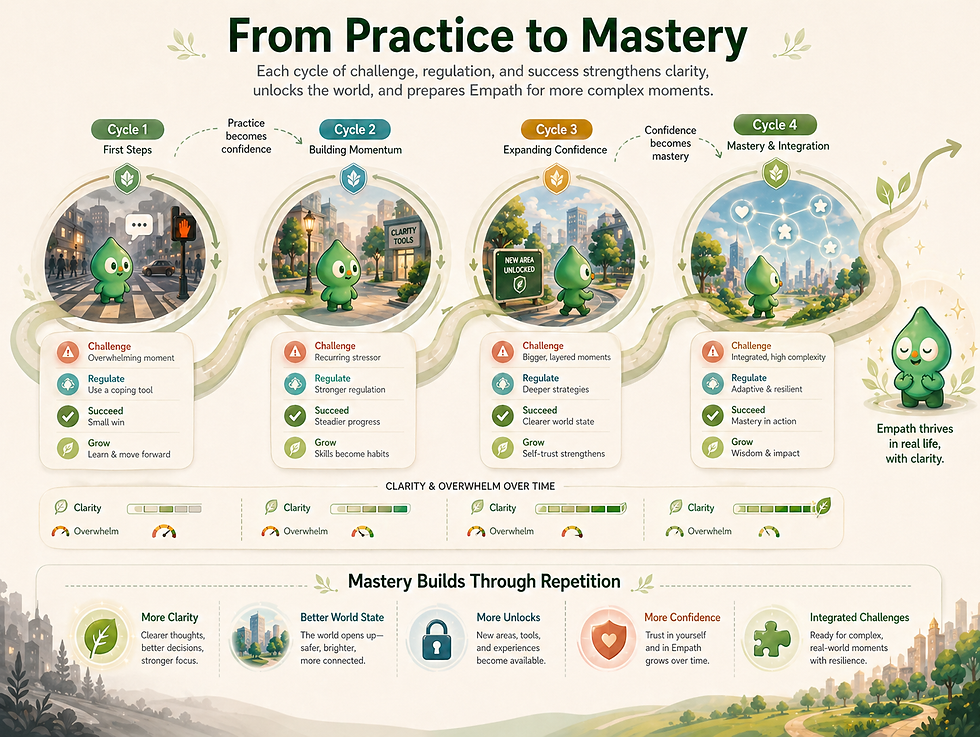
Early feedback has highlighted the strength of the city-as-mind metaphor, Empath as an approachable guide, and the Overwhelm / Clarity system as a clear way to make internal patterns visible. The next step would be structured validation:
prototyping selected mini-games, testing usability and engagement with target users, reviewing therapeutic fit with clinical collaborators, and refining the experience based on evidence-informed feedback before making stronger claims about impact.
Reflection
Help Empath taught me that translating research into design is not about placing evidence-based tasks inside a game shell. It is about understanding the emotional experience behind the task and designing a system where practice feels contextual, visible, and meaningful. Research helped me move from a broad idea about gamified therapy toward a clearer product logic: a character, a world, and a set of mechanics that make attention, interpretation, and regulation easier to understand through play.
Iteration mattered because the strongest version of the project emerged gradually. Each pass made the concept more focused: the city became a mind-world, Empath became the emotional anchor, and Overwhelm / Clarity became the system that connected gameplay to growth. AI-assisted prototyping helped me explore visual directions quickly, test metaphors, and communicate complex systems in a more portfolio-ready way.
-
What I learned: Strong therapeutic design needs both evidence-informed logic and emotionally legible experience design.
-
What changed through iteration: The project shifted from a research-led concept into a coherent game world with systems, progression, and visual identity.
-
What I would validate next: Engagement, usability, emotional safety, and therapeutic fit through prototypes tested with target users and clinical collaborators.
